UKROC 2025 – Case Study – Team Metronauts

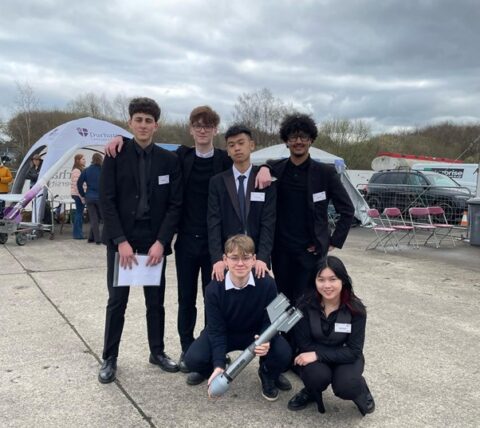
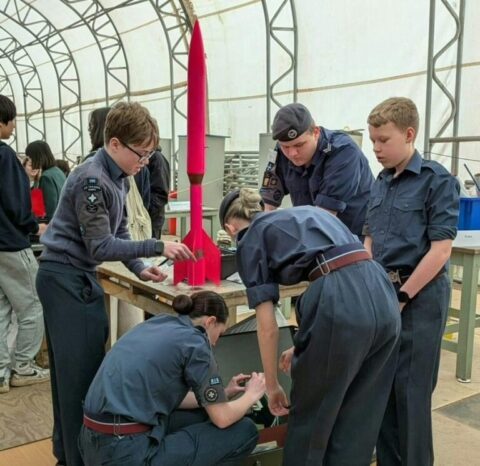
On 25 March 2025 Team Metronauts competed at the Northern regional event (Elvington Airfield, York) against 45 other teams and came third. Unfortunately, they did not make it into the National finals. Here is their untold story…

Setting the Scene

January 2025 Team Metronauts were looking for a competition to help their CVs and support their aspirations of starting future careers in engineering. They found the UK Youth Rocketry Challenge also known as UKROC! Unfortunately, time was tight, the deadline was at the end of January and the regional event was only three months away; they had no experience and no idea where to start.

The Mission

The team needed to build a rocket that sent two eggs to an altitude of 790 feet (241 metres), it then separates and comes down as two separate parts suspended via parachutes. It must land intact without damage to the eggs with a time between 41 – 44 seconds. The maximum weight of the rocket must not exceed 650g and anything outside of this will incur penalty points. 0 points is the best score.

Procurement and Problems

Following rough calculations carried out by the team and SpaceCAD (free analysis software by the organisers), recommendations came out to specify the best sized rocket motors for the job (these are disposable cartridges that can be replaced inside the rocket body).

Unfortunately, due to the late start there were no suitable rocket motors available from the recommended suppliers. The team contacted the rocket motor company to check if anymore would be back in stock, however there was a shortage of supply with only the more powerful motors being available. The team had no choice but to order these powerful motors knowing that it might make the rocket launch twice as high, they had to find a way around it. At this point just building the rocket would be an achievement.

Design and Build

The team used the free SpaceCAD software to design the basic rocket shape, maximum weight, nose cone shape, egg locations and more. This software provides guidance on the rocket thrust power, location and centre of gravity and fin shape. In theory if the rocket was built to this specification the rocket would be perfect. 

Parts were ordered through the recommended supplier, where some parts were not available, the team had to be innovative by modelling it on Inventor (3D CAD) and 3D printing the rest of the parts. 

Budgeting

It was unclear if the team had been granted funding from the school which resulted in major budget constraints. As part of their planning and decision making, they decided to keep a rough budget of £300. The team decided if the budget was not granted, they would split the cost between themselves. The £300 would only get them the basic parts and 3 rocket motors which meant they only had one for testing and the two for the competition. This meant they were limited in test flights.

Testing

Prior to the launch the team had no idea what would happen, they all knew it was going to be higher than the target height due to the powerful motor. As a desperate attempt the rocket was made to the maximum allowable weight.

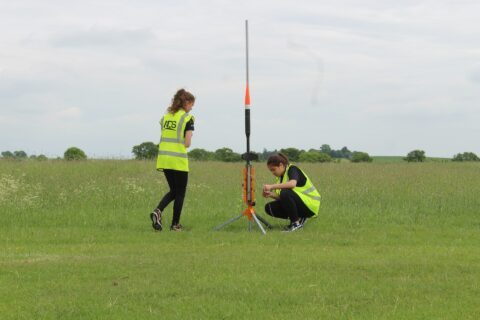
5, 4, 3, 2, 1, lift off! Amazingly the rocket launched, it went high in the sky and the parachute deployed as planned. The test launch was a success, and the eggs survived. The altimeter recorded a height of 317 metres (76 metres over the target) and it landed on 40 seconds! Metronauts have a working rocket!

Development

Team Metronauts knew they needed to reduce the height; they decided to modify the nose cone by making a medium sized cone with a fat nose. Along with this, they added innovative “V” shapes on the wings which they nicknamed the “air brake”. The idea was that these features would create more drag and lower the height of the rocket. The team had to guess, they had no more test flights, and the competition was only a week away.

Competition Day

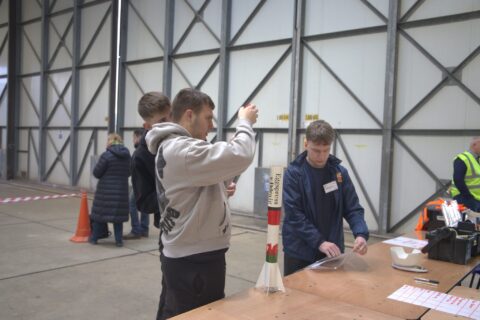
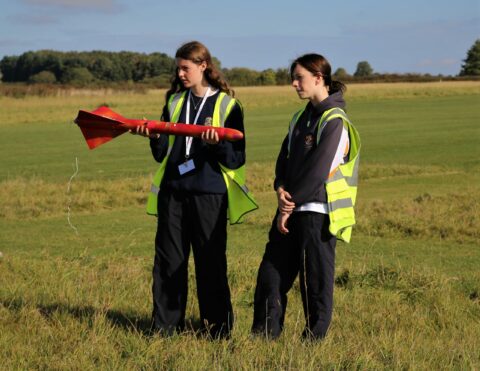
The team arrived at the Northern regional event at Elvington Airfield in York. On their arrival their rocket stood out, it was the strangest looking rocket anyone had seen with the big nose cone and the complicated fins. Team Metronauts was unsure if it was even going to fly because it looked so far away from their original rocket. All the other teams made rockets that looked the same and questioned if the Metronauts rocket was even meet rocket regulations. The event organisers inspected the rocket and confirmed it passed regulations and was suitable for flight, huge relief!

5, 4, 3, 2, 1, lift off! The rocket flew perfectly, it looked stable and separated as planned, it was a bit windy which meant both parts landed in the trees. On retrieval both eggs survived, and the altitude was recorded at 222 metres which was only 18 metres off target. It seemed that the modifications had worked too well. This gave the team a score of 77 points! It was the best of the bunch! 

Towards the end of the day, it looked like no other team could come close to this score, most of them went way too high, eggs cracked, some vanished into the sky never to be seen again and some just simply exploded.

On the second launch attempt, the team was faced with an impossible decision of changing the nose cone to a slimmer one to make it go higher or to stick with the big one? The team decided to go with the big one because they were so far ahead on the score board, they felt it was a done deal. On the second launch the wind was picking up and the launch queue was getting longer. The team had set up the rocket as before and was ready to launch.

5, 4, 3, 2, 1, lift off! The launch was even better than first time, but the wind blew the nose cone straight into the concrete runway where it broke. The eggs survived, but it was later found that the altitude was not recorded due to the flight computer being off. It was discovered that it switches its self-off after 1 hour. On return the team found out that two other teams had beaten them, one at 44 points and the other at 9 points (this was achieved by the reigning champions from last year – the Archers!).

The team was disappointed but still hopeful that they would reach Nationals. However, the team found out it was just not meant to be and that they hadn’t made it to Nationals.

Why?

It is easy to only focus on the winners; this case study is here to highlight the work of Team Metronauts and all the teams that competed and may have not made it to Nationals.

The team started late at no fault of their own and was stuck with the leftover parts, they tried to work with limited time and almost hit the target. They missed the moon but got the eggs home safely on all three flights.

What if they signed up two months earlier? What if the motor was in stock? What if they used a smaller nose cone on the final launch? This is just the way competitions work, the team secured 3rd place by good judgement, demonstrating innovation and creative thinking. These are all the characteristics that are needed to be a trusted engineer. The same attitudes, drama and problems have been witnessed from smaller 10K projects to million-pound projects. UKROC mirrors actual work experience that cannot be replicated. This team has gone through the ups and downs of more than just a school project.

Well done to Team Metronauts and everyone that competed in UKROC 2025.

Thank you to Team Metronauts; Adam Kelly, Adam Sidimoussa, Jessica Tseung, Kevin Huang, Liam Hart and Rakan Ahmed and their supervisor Adrian Tseung CEng MIMechE for contributing to this case study. 


Want to share your experience? Email us ukroc@adsgroup.org.uk.
UKROC regional winners gear up for national finals and Paris showdown

over the past fortnight, we’ve travelled across the UK, hosting our seven regional UKROC competitions. Hundreds of schoolchildren have put their engineering hats on and competed for a spot at the National Finals.

For our four English regionals, we were thrilled to welcome 130 teams from locations as diverse as the Cornish coast to Durham Cathedral.

The challenge for students aged 11-18 was to design, build, and launch a model rocket carrying a fragile payload – an egg. Rockets were tasked with reaching an altitude of 790 feet and to return safely within a strict time window of 41-44 seconds.

Northern Regional

Held at Elvington Airfield near York, the Northern Regional saw 41 teams from across Newcastle, Yorkshire, Greater Manchester, Lancashire, and County Durham take part.

Ampleforth College took home the trophy and have advanced to the UKROC 2025 National Finals, where they will join other regional champions to compete for the national title.

Midlands Regional

Our Midlands Regional saw 6 teams from across Birmingham, Nottinghamshire and Leicestershire put their rockets through the ringers at BMFA Buckminster in Grantham.

Bishop Vesey’s Grammer School topped the tables and will now advance to the National Finals for a chance to represent the UK at the International Finals at the Paris Airshow.

Southeast Regional

Our largest regional competition to date welcomed 69 teams from Essex, Kent, London, Surrey, and Sussex.

Harris Westminster Sixth Form and Tendring Technology College shared the trophy, both securing their place in the UKROC 2025 National Finals.

Southwest Regional

The final regional event took place at Abbeyfield School in Chippenham, the school that took home the 2016 national title.

12 teams from across the region competed for the final spot but it was Abbeyfield that emerged victorious, hoping to make a comeback at the National Finals later in May.

What’s next?

The 8 regional champions now refine their rockets before joining competitors for the National Final on 1 May in Buckminster. 

The winners of the National final will head to Paris, where the UK will defend its two-year title as International Youth Rocketry Champions. 

More pictures from the events can be found here.

Biggest UK Youth Rocketry Challenge sees Slemish College top the Northern Ireland Regional Finals

  • 12 teams took part in the Northern Ireland Regional Finals of the 2025 UK Youth Rocketry Challenge (UKROC)
  • Slemish College are through to the UKROC 2025 National Finals
  • The 2025 UKROC competition will see almost 200 teams of schoolchildren from throughout the UK compete in seven regional competitions


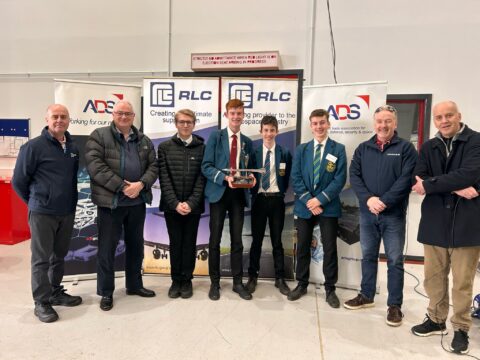
Belfast (25 March 2025) – The Northern Ireland Regional Finals of the 2025 UK Youth Rocketry Challenge (UKROC) saw 12 teams of schoolchildren compete for a spot in the National Finals.

Slemish College have successfully advanced to the UKROC 2025 National Finals where they will join other regional champions to compete for the national title.

The competition sees teams of schoolchildren aged 11-18 design, build and launch a model rocket carrying a precious payload – two raw eggs.

Hosted by RLC Aerospace Limited at Langford Lodge, the winning team from Slemish College surpassed the competition’s altitude target of 790 feet, returning their rocket safely to the ground within the designated time window of 41-44 seconds.

Dr Steve Aiken OBE, Chair of the Northen Ireland Assembly All-Party Group on STEM and David Creighton, Engineering Director at Thales presented the awards to this year’s winners.

Organised by ADS, the UK’s aerospace, defence, security, and space trade association, this year’s competition is set to be the largest and most geographically diverse in the competition’s nearly 20-year history.


Leslie Orr, Director of ADS Northern Ireland, said:

“A huge congratulations to all the students who participated in today’s activities. UKROC plays a vital role in developing the next generation of leaders for our industry. By offering hands-on experience, this competition inspires a passion for STEM, showing that our sectors offer exciting and rewarding career paths. The competition at the National Finals will be fierce, and we wish all the schools the best of luck for the competition ahead.”

The 2025 UKROC competition will see almost 200 teams from throughout the UK compete in seven Regional Finals. The winners of the National final will head to Paris, where the UK will defend its two-year title as International Youth Rocketry Champions.”


The 2025 competition is kindly sponsored by Airbus and Lockheed Martin.


13 teams of Welsh schoolchildren go rocket-to-rocket at the UKROC regionals

  • 66 students took part in the inaugural Welsh regional finals of the 2025 UK Youth Rocketry Challenge (UKROC)
  • Haverfordwest High VC School are through to the UKROC 2025 National Finals
  • This year’s competition is set to be the largest and most geographically diverse in the competition’s almost 20-year history

Snowdonia (24 March 2025) – The inaugural Welsh regional finals of the 2025 UK Youth Rocketry Challenge (UKROC) saw 13 teams of students from 6 Welsh schools compete for a spot in the National Finals.

The competition sees teams of school children aged 11-18 design, build and launch a model rocket carrying a precious payload – an egg.

Haverfordwest High VC School have successfully advanced to the UKROC 2025 National Finals, where they will join other regional champions to compete for the national title.

Organised by ADS, the UK’s aerospace, defence, security, and space trade association, this year’s competition is set to be the largest and most geographically diverse in the competition’s nearly 20-year history.

Hosted at the Snowdonia Space Centre, the rockets were tasked with reaching an altitude of 790 feet and returning safely to the ground within a time window of 41-44 seconds.

Kevin Craven, CEO of ADS, said:

“A huge congratulations to all the students who participated in today’s activities. UKROC plays a vital role in developing the next generation of leaders for our industry. By offering hands-on experience, this competition inspires a passion for STEM, showing that our sectors offer exciting and rewarding career paths. The competition at the National Finals will be fierce, and we wish all the schools the best of luck for the competition ahead.”

Inaugural Welsh Competition

The Welsh regionals took place for the first time in 19 years thanks to funding from the UK Space Agency secured by the Snowdonia Aerospace Centre. This essential funding supported travel and equipment costs, helping to widen access to the competition for schools right across the region.

Jeremy Howitt, Snowdonia Aerospace Centre said:

“Today has showcased some incredibly talented and innovative young people from across Wales. As the proud hosts of today’s event, we congratulate all the schools for their remarkable effort – building a spacecraft is no small feat. Wales is a thriving hub of space innovation, and initiatives like these are helping to secure the future of our sector and provide the vital pipeline of talent we need. We encourage all participants to explore the rewarding and exciting opportunities available in our growing space sector.”

Qualifying teams will now refine their rockets before joining competitors for the National Final on 1 May in Buckminster.

The 2025 UKROC competition will see almost 200 teams of schoolchildren from throughout the UK compete in seven regional finals. The winners of the National final will head to Paris, where the UK will defend its two-year title as International Youth Rocketry Champions.

The 2025 competition is kindly sponsored by Airbus and Lockheed Martin.


UK retains International Youth Rocketry Championship Title

  • The UK Youth Rocketry Champions, Ampleforth College Rocket Club, have won the international edition of the competition, marking the UK’s second consecutive victory. 
  • The competition, held at Farnborough International Airshow, took place between France, Japan, the UK and the US  
  • The competition is strongly supported by the aerospace and defence industry as a part of combatting the significant skills shortages they face. 

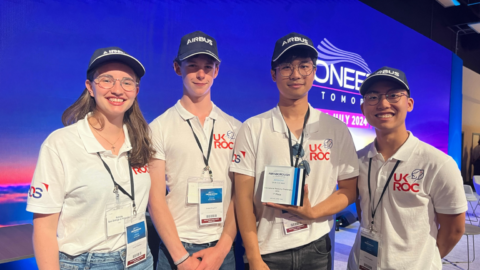
Farnborough International Airshow (26 July 2024) – A team of students from Ampleforth College in Yorkshire has beaten teams from Japan, the USA and France to add the title of International Youth Rocketry Champions to their status at the UK Champions. 

The UK’s participation in the competition is facilitated by ADS, the trade association for the aerospace, defence, security and space sectors, to support STEM engagement in schools. A team from each country is tasked with designing, building and launching a model rocket to carry a fragile payload: a raw egg. 

The UK competition, and the UK’s participation in the international final, is sponsored by Airbus and Lockheed Martin. This is a prime example of industry giving their support to creating the next generation of STEM professionals. 

Skills shortages in STEM are a serious challenge for the UK economy, with the aerospace, defence, security and space sectors consistently reporting over 10,000 vacancies across their businesses. Furthermore, a July 2024 survey of ADS members found that recruitment is the area that the joint highest proportion of businesses plan to invest in or have already invested in across 2024. 

The event took place as part of Farnborough International Airshow’s Pioneers of Tomorrow, a day of the prestigious airshow dedicated to STEM-focused events designed to inspire and engage the next generation of aerospace leaders.   

Kevin Craven, CEO of ADS said: 

“Congratulations to Ampleforth College Rocket Club on their amazing victory, the second year in a row as international champions for the UK. The UK Youth Rocketry and International Youth Rocketry Challenges are fantastic examples of how our sectors are committed to encouraging young people across the UK into STEM careers. We touch more than 5000 young people globally with the Rocketry Competition and it is desperately important as our sectors continue to face significant skills shortages that hold back our ability to provide high skill, high productivity jobs for the economy. That is a challenge industry cannot solve alone, despite great initiatives like this. We must have partnership and adequate support from Government to unlock our full economic potential.” 

Matt Archer, Launch Director at the UK Space Agency, said: 

“As we countdown to the first vertical rocket launch from UK soil later this year, it is more important than ever for the whole of the space industry to be proactive in our support for the next generation of STEM professionals. A strong pipeline of talent is vital for our plans to grow this sector, and competitions like this play a significant role in giving students the chance to learn and to showcase their skills and ideas. Congratulations to Ampleforth College Rocket Club on becoming international champions.” 

UK Youth Rocketry Challenge final back with a blast

On Thursday 7 October 2021, six teams from across the country went head-to-head in a final to be crowned national champions. All they had to do was to design, build and launch a model rocket carrying a fragile payload (usually a raw egg) which is brought back to the ground safely and without breaking! It’s an opportunity for young people to get engaged in STEM in a fun and exciting way.

  • 1st Place: Team Vesuvius from King Edwards School, Bath
  • 2nd Place: Team NHASA from North Halifax Grammar School
  • 3rd Place: Team Icarus from Epsom College.

The honourable finalists were:

  • Physics Nerds from NHGS
  • Gordonstoun Rocketeers from Gordonstoun School
  • Where are My Engines, Holt? from Tiffin School

Congratulations and thanks to our sponsors Lockheed Martin and Royal Aeronautical Society for supporting the event.

UK Youth Rocketry Challenge (UKROC) Cancellation Statement 18.3.20

The welfare of everyone involved in participating and running the UK Youth Rocketry Challenge is of the utmost importance to us.

Following the Government’s advice to avoid unnecessary travel and non-essential contact with other people in support of its efforts to delay and prevent the spread of Coronavirus in the UK, it will no longer be appropriate to run the UK Youth Rocketry Challenge regional events that are due to commence from next week. Therefore, it is with regret that we announce the cancellation of this year’s competition.

We will re-focus our efforts in planning the competition for next year and for those schools involved this year, we will be contacting you very soon about carrying over your registrations. We look forward to welcoming participating schools to future editions of the UK Youth Rocketry Challenge and we will keep you updated on our future plans.

Please take care of yourselves and your families over the coming months.

Thank you for your support.

Best wishes
UK Youth Rocketry Team

Welcome to the new website

This week we – the UK Youth Rocketry Challenge (UKROC) – have launched our new look branding and website thanks to help from event organisers ADS and our sponsors and partners Lockheed Martin, UKspace and the Royal Aeronautical Society.

At UKROC, the UK’s largest youth model rocket competition, we aim to enthuse more young people about the subjects needed in aerospace, defence, security and space industries – science, technology, engineering and maths. We believe – and hope you do too – that it is a fun and engaging way for young people in the UK to learn more about engineering and physics.

Our new website reflects a revitalised approach to the competition, with a focus on greater engagement with you throughout the competition, an easier process to sign up and a more modern design. It’s UKROC as you’ve never seen it before!

You can now meet our rocketeers who will be guiding you through the process of building your rocket with hints and tips along the way! Pay attention to what they say as they’ll form part of the judging panels for the regional and national finals.

We will also be launching an Instagram page where we will be running competitions and hope to showcase participants’ progress throughout the competition.

Stay tuned and be sure to check back to our new website for the latest updates and information!